Pet grief: why we need a ceremony
When a human being dies, everything is provided for. A ceremony, a place, flowers, loved ones gathered, words spoken out loud. These gestures are not decorative: they are the mechanism through which humans have moved through loss for thousands of years.
When a pet dies, there is nothing. One last visit to the vet, a food bowl you can't bring yourself to put away, and silence. No ceremony, no place, and often not even the social permission to be sad. It is this void — not the sadness itself, but the absence of a framework to live it in — that makes pet grief so hard. And it is precisely this void that AmiAmor was created to fill.
A real sorrow, measured by science
Let's start by sweeping away the "it was just an animal". Research says otherwise, and has for a long time.
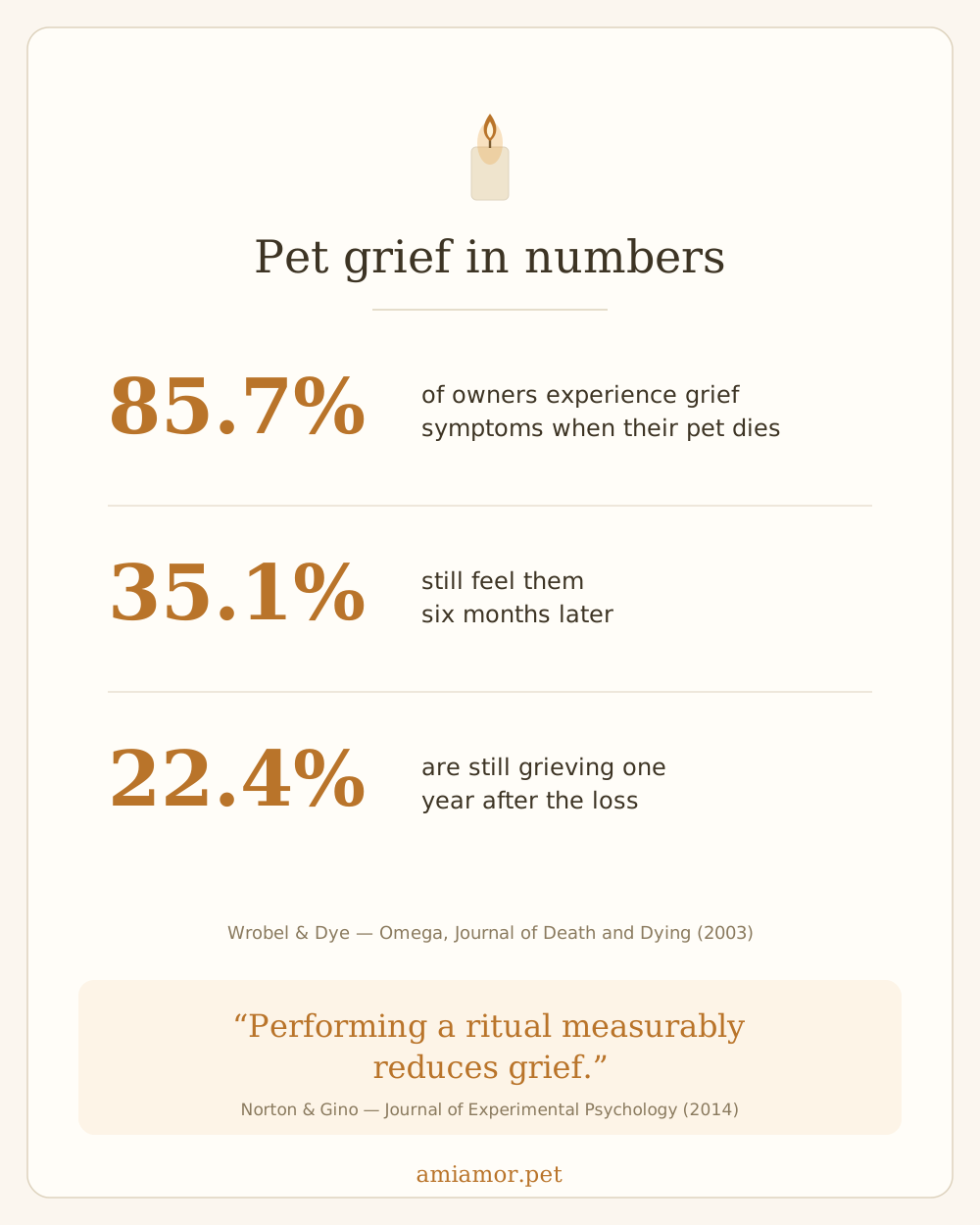
In a landmark study published in Omega — Journal of Death and Dying, psychologists Thomas Wrobel and Amanda Dye followed hundreds of bereaved owners: more than 85% showed clear symptoms of grief when their pet died — the same ones seen after losing a loved one: sleep problems, loss of appetite, uncontrollable waves of sorrow. A third still felt them six months later, and more than one in five a full year on.
These numbers are no surprise once you measure the true place a pet holds: in many countries, more than one household in two shares its life with a companion animal, usually for ten to fifteen years. Ten or fifteen years of daily presence, shared routines, unconditional affection. The loss that follows is not a small sadness: it is grief in the full sense of the word.
The grief nobody acknowledges
American psychologist Kenneth Doka gave a name to what people who lose a pet go through: disenfranchised grief. A grief that is entirely real, but that those around us — and society at large — do not validate. No day off, no announcement, no condolences. And too often, a "you'll get another one" by way of comfort.
Doka's work shows that this is exactly what makes grief worse: when sorrow is not allowed to exist publicly, it doesn't disappear — it festers. The bereaved person ends up alone, hiding a pain that nothing helps them cross. The problem with pet grief is not its depth. It is its invisibility.
What ceremony repairs
If humans have held funerals since the dawn of time, it is not out of empty tradition. In 2014, researchers Michael Norton and Francesca Gino (Harvard) published in the Journal of Experimental Psychology a series of experiments on the role of rituals after a loss. Their conclusion is remarkable: performing a ritual measurably reduces the intensity of grief and restores a sense of control — and it works even for people who say they don't believe in the power of rituals.
The mechanism is simple and deeply human. A ritual turns a loss that was suffered into an act that is accomplished. It provides a moment (the ceremony), a place (the grave, the memorial), symbols (the candle, the flowers, the words) and witnesses (the loved ones who mourn with us). Four things grief needs to do its work — and four things pet grief is almost always denied.
A true ceremony, accessible to everyone
That realisation is what gave birth to AmiAmor — after the loss of Bouboule, a cat who shared sixteen years of its founder's life. Not "yet another web page", but the online reconstruction of what funerals have always offered:
A place. A memorial page for your pet, with their name, their photos, their story. Somewhere that exists, that can be visited, that you can return to on the dates that matter.
Symbols. You light a candle there, the universal gesture of remembrance. You choose a symbol for your companion. These simple gestures are exactly the ones whose soothing effect Norton and Gino measured.
Witnesses. The guestbook lets family and friends leave a word, a memory, a thought. Grief stops being invisible: it is acknowledged, shared, legitimised — the precise antidote to the disenfranchised grief Doka described.
Words. Writing your pet's story — how they arrived, what they loved, what they leave behind — is the equivalent of a eulogy: putting the loss into a narrative so it can be carried.
Creating a page is free and takes a few minutes, because a ceremony should never be a privilege. Those who wish to can then make the page permanent, the way one engraves a stone.
You are not alone
Every year, millions of dogs and cats reach the end of their lives, in every country. Behind each one, a person or a family going through what you may be going through today.
Your sorrow is normal. It is documented, measured, legitimate. And there is now a place to lay it down.
Sources
Wrobel, T. A. & Dye, A. L. (2003). "Grieving Pet Death: Normative, Gender, and Attachment Issues", Omega — Journal of Death and Dying, 47(4).
Doka, K. J. (1989, 2002). Disenfranchised Grief: Recognizing Hidden Sorrow. Lexington Books.
Norton, M. I. & Gino, F. (2014). "Rituals Alleviate Grieving for Loved Ones, Lovers, and Lotteries", Journal of Experimental Psychology: General, 143(1).